
YouAlreadyDraw.Now MakeIt Move.
Structured fundamentals for self-taught artists who are done watching tutorials and ready to actually finish something. Timing. Weight. Acting. The principles that transform flat shapes into moving ones.
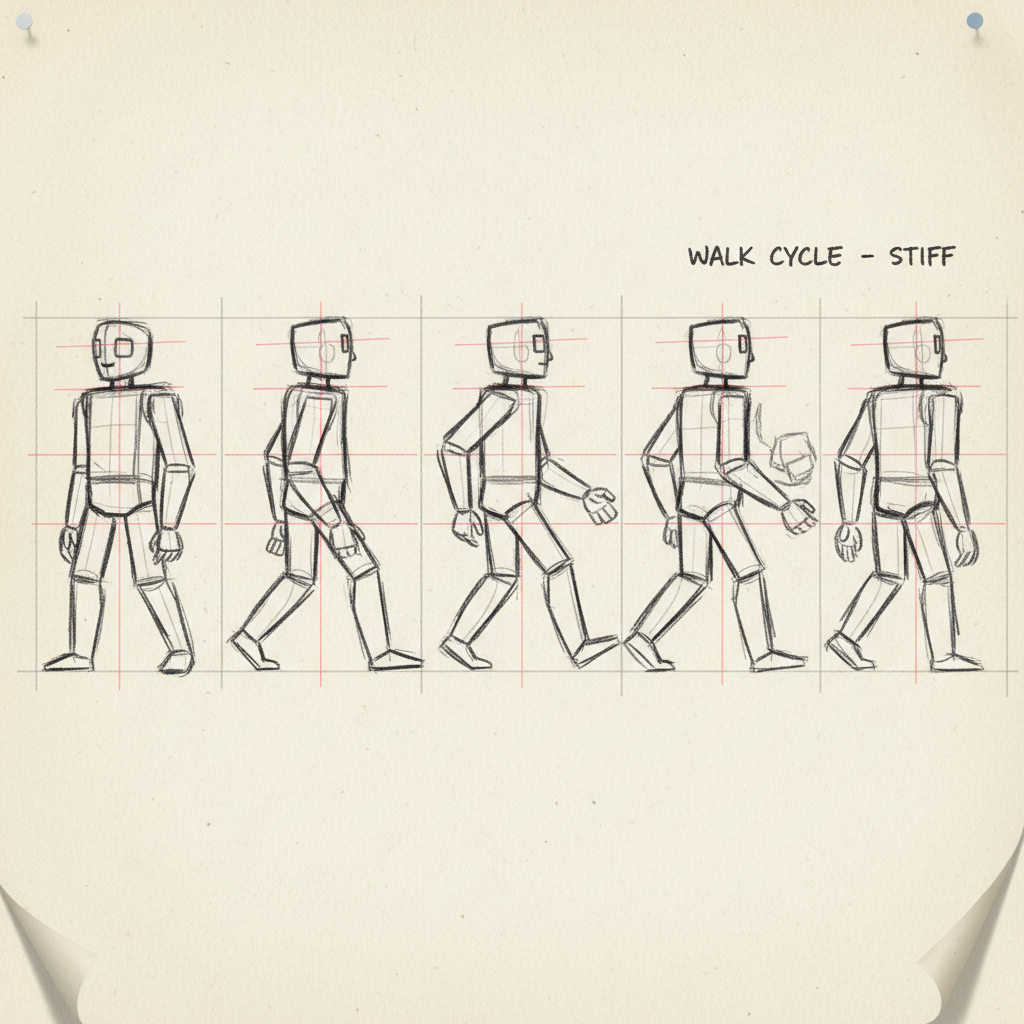
A walk cycle built frame by frame — the first thing you'll make.
You're not stuck because you can't draw.
You're stuck because nobody taught you how to think.
The gap between "I can follow a tutorial" and "I can make this myself" isn't talent. It's structure. It's the 12 principles that Disney animators developed in the 1930s and that every studio still tests for — and that almost no YouTube video actually teaches properly.
Tutorial Purgatory
You've watched 200 hours of YouTube. You can follow along perfectly. But close the tab and you freeze. Nothing you make feels like yours.
Portfolio Rejection
You applied to studios. The work wasn't bad — it just looked unfinished. Stiff. Like something was missing but you didn't know what.
Impostor Syndrome
Real animators studied at CalArts or Gobelins, right? You're self-taught. You've never had anyone tell you what you're actually doing wrong.
"The tutorials taught me what to press. Nobody taught me what to feel for."
— Maya Okonkwo, enrolled March 2025, now working at Psyop
The 12 Principles aren't tricks. They're physics.
Timing & Spacing
The difference between a robot and a human in motion.
Squash & Stretch
How living things deform under force. Physics made visible.
Anticipation
Every action is preceded by the opposite. Without it, movement is invisible.
Weight & Follow-Through
Objects have mass. When they stop, parts keep going.
Arcs
Nothing in nature moves in a straight line. Everything curves.
Acting & Performance
The difference between movement and storytelling.
The 12 Principles aren't a checklist. They're a language.
Developed by Disney's Nine Old Men and published in The Illusion of Life (1981), these principles are still the foundation of every professional animation studio's review process. Here's what they actually mean.
Squash & Stretch
The most fundamental principle. Gives weight and flexibility to objects.
Anticipation
Prepare the audience for what's about to happen. The windup before the pitch.
Staging
Present ideas in the clearest way. Silhouette is everything.
Straight Ahead & Pose-to-Pose
Two approaches to animation. Each has a use case. Both are essential.
Follow Through & Overlapping Action
Nothing stops all at once. Secondary parts keep moving after the main body stops.
Slow In & Slow Out
Ease in, ease out. The rhythm of natural movement. No mechanical starts or stops.
Arcs
All movement follows an arc. Straight lines are robotic. Curves are alive.
Secondary Action
Supporting actions that reinforce the main action. A character walks and talks.
Timing
The number of frames. More frames = slower, heavier. Fewer = faster, lighter.
Exaggeration
Animation is not imitation. It's heightened reality. Push it further than you think.
Solid Drawing
Weight, depth, and balance. Your drawings must feel three-dimensional.
Appeal
Charisma. The quality that makes an audience want to watch. Craft this consciously.
Animation Vocabulary
What you'll understand after Module 1
Why your bouncing ball looks wrong (it's the timing, not the drawing)
The difference between 12s and 24s animation and when to use each
How to read a graph editor without a degree in math
Why squash and stretch isn't just for cartoons
The single biggest mistake self-taught animators make on their first walk cycle
Free Resource Available
The 12 Principles Cheat Sheet — all 12 principles, visual examples, and when to apply each. One page. Free forever.
Download free ↓11 weeks. Four modules. One portfolio-ready demo reel.
Each module builds directly on the last. By the end, you'll have four finished animation pieces and the vocabulary to talk about them in a studio interview.
Get the 12 Principles Cheat Sheet
One page. All 12 principles, visual examples, and exactly when to use each. Used by 4,800+ students. Free forever.
No spam. One email with the PDF. That's it.
Before and after. The work doesn't lie.
Toggle between Week 1 and the capstone for each student. This is 11 weeks of structured practice, not talent.
"I applied to three studios in my 8th week of the course. Two called back. One hired me."
Maya Okonkwo
Former Graphic Designer → Animator at Psyop

"The timing module alone doubled my rate. Clients can feel the difference even if they can't name it."
Theo Nakashima
Self-taught artist → Freelance Motion Designer
"My admissions interviewer said my timing sense was "unusually developed for a high schooler." I'd been studying for 11 weeks."
Priya Menon
High school student → CalArts BFA admit
Take something with you. No strings.
Real knowledge before you commit to anything. If these resources don't convince you the curriculum is worth it, nothing will.
12 Principles Cheat Sheet
All 12 principles on one page with visual examples. The most-downloaded resource we've ever made.
Download PDFFree Masterclass: Timing & Spacing
20 minutes. No email required. The single most important lesson in animation, taught clearly.
Watch FreeBouncing Ball Exercise Pack
Five bouncing ball variations with reference sheets. The fastest way to understand weight.
Download FreeThe 12 Principles Cheat Sheet
Every principle. Visual examples. When to use each. Used by 4,800+ students as their first-day reference. One page, forever.
Free Masterclass: Timing & Spacing
20 minutes · No email required · The foundation of everything